
The EU AI Act and pressure from inside the company push many organizations to set up “AI governance”. Often what emerges is a committee that reviews every AI initiative and slows it down. Governance earns a reputation for blocking, and the business units learn to route around it.
That is avoidable. Good governance runs along as an operating model that enables delivery. The real question is how to anchor it so it allows fast, auditable execution.
In short: Governance works when it is an operating model: clear roles, decision bodies and evidence, built into delivery. That way it enables fast, auditable AI.
Three building blocks of an operating model
A workable governance model rests on three building blocks. Take one away and it tips over: too much role without a body creates friction, too much body without evidence creates theater.
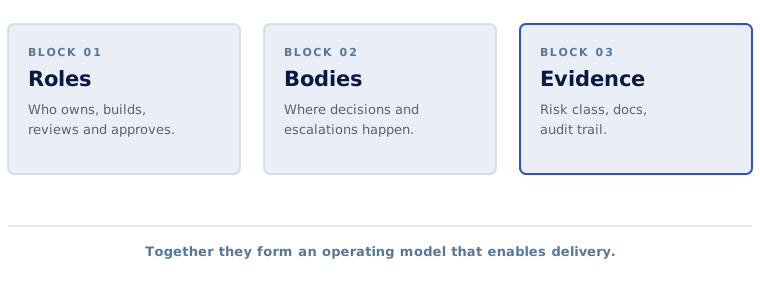
- Roles. Who owns an AI system, who builds it, who assesses the risk, who approves it? Clear accountability is the foundation; without it, every rule gets lost.
- Bodies. Where are risks assessed, exceptions decided and escalations resolved? A lean decision body with a clear mandate replaces endless rounds of alignment.
- Evidence. What proof emerges automatically in the process: risk class, model documentation, test results, audit trail? Only evidence turns “we care about governance” into “we can show it”.
Governance as part of delivery
The decisive lever is to build the controls into the lifecycle, so they take effect as you build. Risk classification belongs at the start, when a use case is set up. Model documentation emerges during development, well before any audit sprint. Monitoring runs along in production, with defined thresholds and a clear path when quality drifts.
This turns governance into a by-product of disciplined delivery. The evidence accrues while you build, and the dreaded audit becomes a query of artifacts that already exist.
What the AI Act and ISO 42001 share
The frameworks rest on the same logic. The EU AI Act is risk-based: the higher a system’s risk, the stricter the obligations. ISO 42001 describes a management system for AI: roles, processes, continuous improvement, documented and auditable. At their core both demand the same things: clear accountability, classification by risk, robust documentation and a mechanism that improves. Build your operating model along this shared logic and you stay ready for the next framework, without starting from scratch each time a new rule appears.
The most common mistake
The costliest mistake is treating governance as a one-time gate: an approval meeting before go-live, then silence. But AI systems change in operation, data drifts, usage shifts, models get swapped. Governance that only acts at the start loses sight precisely when the risk becomes real. An operating model accompanies the system across its whole lifecycle and checks back at recurring points.
What this means for leadership
Governance is an operating decision. Three questions are best clarified early: are the roles clear enough that someone owns every AI system? Does the decision body have a real mandate? And does the evidence emerge automatically in the process? Build these three blocks and embed them into the lifecycle, and you get governance that speeds up delivery and keeps it auditable. That is how a binder becomes an operating model that holds in daily work.