
Over the past years many companies automated their processes with RPA: fixed scripts that run through clearly defined steps. That works reliably as long as the process stays stable and predictable. The moment an exception appears, the automation stops and a human takes over.
Agentic AI changes this logic. These systems do more than follow a path: they plan, evaluate intermediate results and choose their next step. With that, the leading question shifts from “how do I automate this process?” to “which decisions do I hand to a system, and under what controls?”
In short: Agentic AI moves decisions from the script into the system. The value goes to those who decide early what gets delegated, how it is monitored and where the human stays accountable.
Three levels worth separating
Between classic automation and a fully autonomous agent lies a spectrum. Knowing it lets you pick the right level for each task instead of reflexively reaching for the highest one.
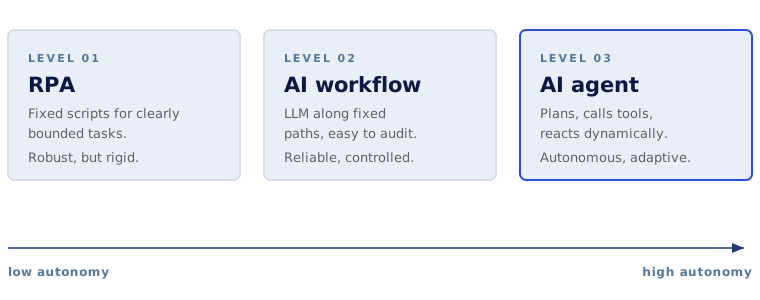
- Rule-based automation (RPA). Fixed scripts for clearly defined, repetitive tasks. Robust, but rigid: every new exception needs a new rule.
- AI workflows. A language model works along predefined paths, for example to classify, extract or summarize. Reliable and easy to control, because the human sets the sequence of steps.
- AI agents. Autonomous systems that steer their own process dynamically, call tools and react to intermediate results. Powerful on open-ended tasks, demanding to run.
Autonomy rises with each level, and so does the effort for control and observation. Most of today’s dependable enterprise value sits in workflows and hybrids. Pure agents pay off where tasks are too varied to cast into paths in advance.
How an agent works
An agent follows a loop: it breaks a goal into steps, calls tools (search, databases, APIs), evaluates the result and corrects its course. That feedback makes it adaptive, and it is exactly what calls for a frame around it.
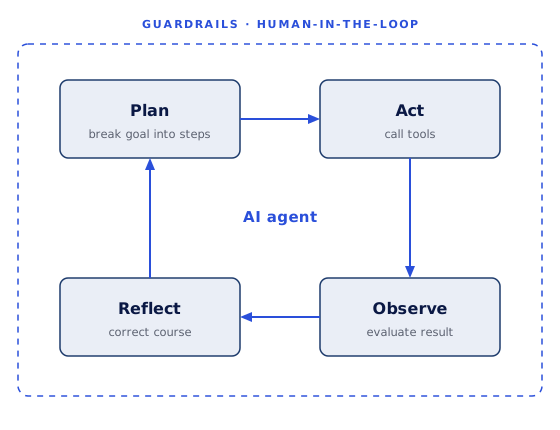
The loop is only as good as its guardrails. Without clear boundaries, logging and a defined point where a human takes over, adaptability turns into uncontrolled risk. The guardrails belong to the system.
When a workflow, when an agent
The choice depends on the task. Clearly bounded, recurring processes like monthly reporting run best as a workflow: predictable, auditable, cheap. Dynamic situations with many exceptions, such as fraud detection or handling unstructured requests, benefit from the autonomy of an agent.
A simple heuristic helps decide:
- Is the path predictable? Then a workflow. Predictability is cheaper and safer than autonomy.
- Are the exceptions numerous and hard to specify upfront? Then an agent is worth it.
- Is a lot at stake? Then keep a human in the decision path, regardless of the level.
In practice, hybrids are common: a structured workflow that delegates individual, tightly bounded steps to specialized agents. The overall flow stays auditable, while autonomy works where it is actually needed.
The step into production
The pilot is rarely the problem. The hard part is running it day after day. An agent that acts on its own needs clear boundaries, observability and defined escalation paths to people. Five questions decide whether it is production-ready:
- Boundaries. Which actions may the system take, and which never?
- Traceability. Can every decision be logged and explained?
- Accountability. Who owns the outcome, and where does a human step in?
- Evaluation. How do we measure quality, and how do we notice when it slips?
- Security and cost. How do we protect the agent from manipulated inputs, and do the call costs stay in bounds?
Most of these questions sit in the organization. That is where it is decided whether an impressive pilot demo becomes a system that holds up in daily use.
2026: agents that act
In 2026 the standards that make agents capable are maturing. Protocols like the Model Context Protocol connect models with tools and data. Approaches like the Universal Commerce Protocol from Shopify and Google let agents actually execute transactions across providers. For companies this means the next wave of automation does more than answer: it acts, from placing an order to making a booking. Make your systems discoverable and connectable, and you become reachable for these agents in the first place.
What it means for leadership
Agentic AI is more than a larger version of RPA. It moves decisions into systems and raises new questions about control, operations and organization. For leadership, three tasks follow: use the spectrum deliberately instead of declaring every task an agent, build the guardrails as part of the product, and decide early who answers for an agent’s actions. The value goes to those who ask these questions before the first pilot, not after the first incident.