
AI budgets keep rising, yet the question of value contribution is often met with silence or a number no one takes seriously. That is rarely a technology problem. It is a question of how the math is done: gross savings get celebrated, running costs stay hidden, and value that does not show up in a quarterly figure falls off the table.
As a PhD economist, I see a familiar pattern here. An investment can only be judged if both sides are stated in full: the benefit across its whole breadth and the cost across its whole lifetime. With AI, both are routinely cut short, and that is exactly where the gap between promise and result opens up.
In short: The return on AI is rarely decided by the model. It is decided by whether you account for the full value and the full cost honestly, looked at as a portfolio, and over a realistic time horizon.
Why the simple ROI formula misleads
The common calculation is: hours saved times hourly rate, divided by project cost. It overstates the benefit and understates the cost at once. Hours saved rarely become real savings unless someone deliberately redirects the freed capacity. And project cost does not end at go-live: an AI system incurs cost for as long as it runs.
The math only becomes serious when it looks at net value, the contribution after deducting every cost the system causes over its lifetime. Only this net value can carry a decision. A gross figure belongs on the slide.
Four value drivers that count
To capture the value of AI honestly, look beyond pure efficiency. Four drivers shape the contribution, and the most valuable are the ones most often overlooked.
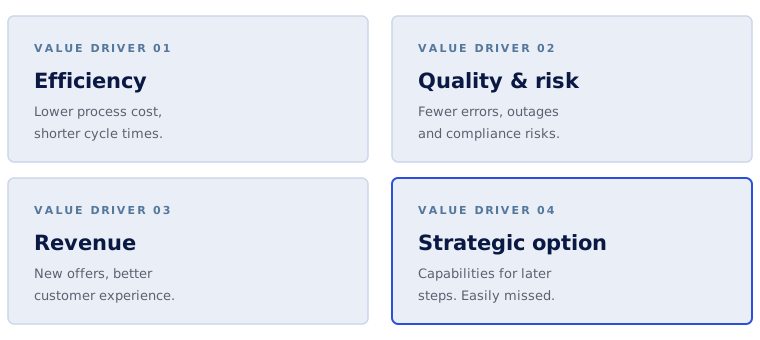
- Efficiency. Lower process cost and shorter cycle times. Quickly measurable, which is why this driver dominates most calculations.
- Quality and risk. Fewer errors, fewer outages, lower compliance risk. Harder to quantify, yet often the bigger lever, especially in regulated industries.
- Revenue. New offers, better customer experiences, faster response in the market. It works over the medium term and rarely shows up in pure cost calculations.
- Strategic option. Capabilities, data and platforms that make later steps possible in the first place. Their value lies in the future and escapes any short-term view.
Count only the first driver and you make AI artificially small. All four drivers together, with honest uncertainty on the latter ones, give a realistic picture.
The cost side no one likes to count
The total cost of an AI system reaches far beyond development. Four blocks belong in any honest calculation:
- Build: data, development, integration into existing systems.
- Run: inference cost, monitoring, regular retraining as quality drifts.
- Govern: risk classification, documentation and oversight, especially under the EU AI Act.
- Adopt: training, change and the effort it takes before people genuinely use the system.
The run phase is the one most underestimated. A model that convinces in the pilot can become expensive in continuous operation, when every request incurs compute cost and quality drifts without care. What matters is the three-year view: what the system costs across its whole lifetime, from build to running operation.
Think in a portfolio
Measuring individual AI projects against a short-term ROI threshold quietly favors the small, safe efficiency cases and starves the large, uncertain bets whose value only becomes visible later. Yet those strategic options decide long-term competitiveness.
A portfolio resolves the tension. Short-term efficiency cases fund the journey and build trust. Medium-term revenue and quality cases build on top. A few strategic bets are allowed to be measured against a longer horizon, with a clear hypothesis and a point at which you review them honestly. The result is a balanced picture of fast effects and long-term potential.
What this means for leadership
The return on AI is decided by honest accounting. Three things belong on the leadership table: the full value across all four drivers, with open uncertainty on the latter ones; the full cost across the lifetime, including run and governance; and the portfolio view that links short-term effects with long-term potential. Account for it this way, and you get a number that withstands scrutiny and genuinely carries an investment decision.