
Many companies have successful AI pilots but strikingly few scaled systems. Between the two lies what you might call pilot purgatory: impressive demos that never reach standard operation. The cause is rarely the technology. It lies in the organization.
A pilot lives on energy, a small team and short paths. Standard operation demands more: fixed roles, reliable funding and an operating model that holds even after the early enthusiasm has faded. Underestimate that and you build pilots that never arrive.
In short: The leap from pilot to standard operation is an organizational question. It is decided by roles, skills and an operating model that carries AI in daily work, long before a better model counts.
Why pilots get stuck
A pilot is a project with heroes: a few committed people who put in extra effort and carry the system across the line. That works once. It does not scale. The moment one pilot is meant to become ten systems, the structure to carry them is missing: no one owns them permanently, the funding was one-off, and the knowledge sits in a few heads.
The AI-ready organization solves this by turning the project into a standing capability. Three layers have to grow with it.
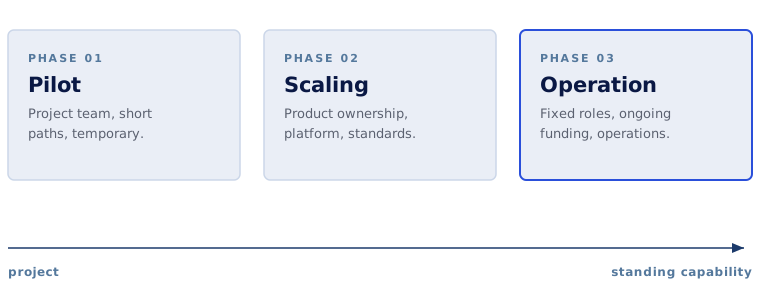
Three layers that have to grow
- Roles. The project team becomes product ownership: someone owns the AI system permanently, with a clear mandate. Behind it sits a platform team that provides shared building blocks, so not every initiative starts from zero.
- Skills. AI competence cannot stay confined to the data science team. Business units that assess use cases, leaders who prioritize, and staff who work with the systems each need their measure of AI literacy. Adoption emerges where people understand what a system can do and where its limits lie.
- Operating model. Funding, prioritization, support and monitoring move from one-off project files to standing functions. An AI system in standard operation needs a budget to run, a path for failures and a place where the next expansion is decided.
The shift in the operating model
The most important step is the move from project logic to product logic. Projects have a beginning and an end; an AI system has neither: it runs, it drifts, it needs care. As long as AI is funded as a sequence of projects, every system falls into a gap after go-live. Lead AI as a product with ongoing budget and fixed ownership, and you close that gap.
This also changes how success is measured. A pilot is measured by proof: does it work in principle? A product is measured by operation: does it hold reliably, at acceptable cost, with satisfied users?
The role of leadership
The organization does not align itself. Leadership creates the conditions: it makes AI capability a permanent function with its own budget, it removes the organizational friction on which pilots fail, and it sponsors the uncomfortable shift from project to product. Above all, it treats AI competence as what it is: a capability the company builds and keeps.
What this means for leadership
The bottleneck on the path to scaling AI is rarely technical. It lies in roles, skills and an operating model that carries AI beyond the pilot. Three questions are worth asking early: does every productive system carry permanent ownership? Does AI competence reach beyond the data science team into the business and leadership? And do we fund AI as an ongoing product? Build these layers and you turn successful pilots into a standard operation that holds. That is how a company becomes AI-ready.